

Advanced search function
DocsWhen thinking of an advanced search function, you might imagine complex search functionality with many input fields and mathematical calculations. KLEKSI's search function offers the same options, but in a contemporary and very user-friendly way. You will find the extensive search function in the overview of all descriptions and/or objects, in the lists you have created, in the advanced selection lists, in the overview of every type of procedure (loans, restorations, etc.), and in the bulk modification function.
At first glance, the new search function looks like any simple search function with just one input field, but as soon as you click on the input field, you will discover that much more is possible. 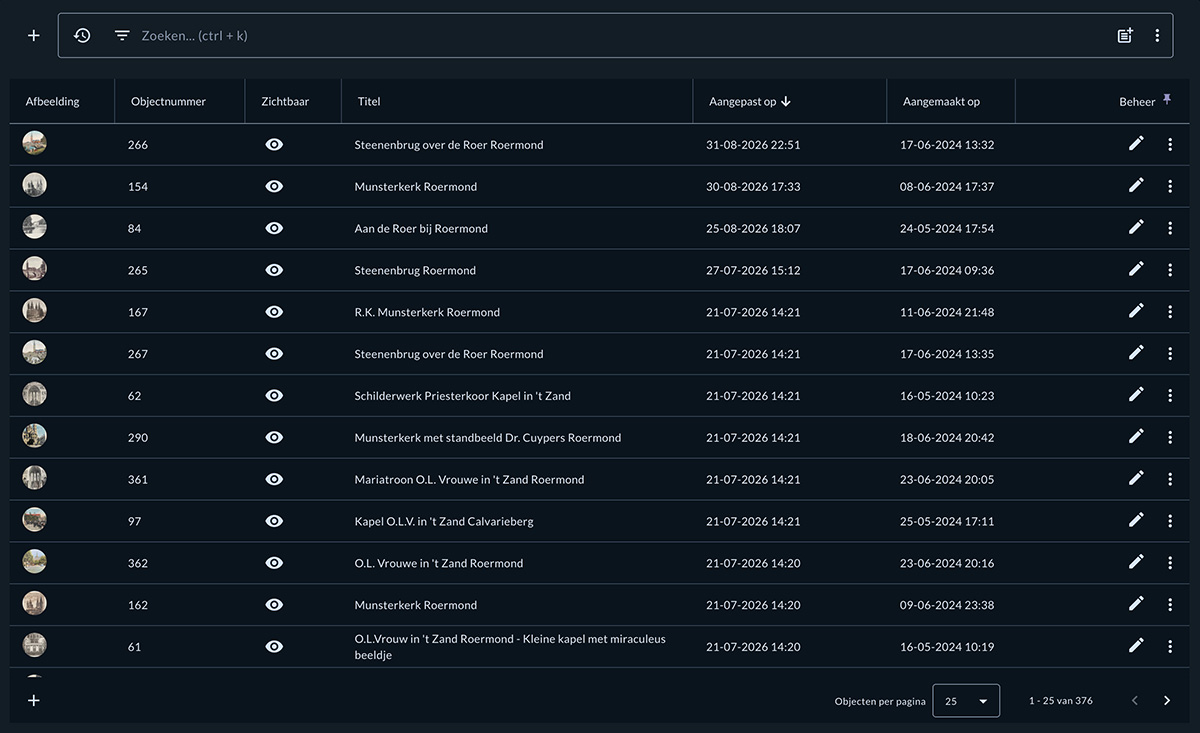
As with any search function, you can search by entering a word you are looking for. As soon as you click in the search field, a list of all input field names present in your system opens below.
You can also enter the name of a field in the search bar to quickly find the specific field you want to set as a filter. This way, you do not have to scroll through all the fields (if you have many fields). 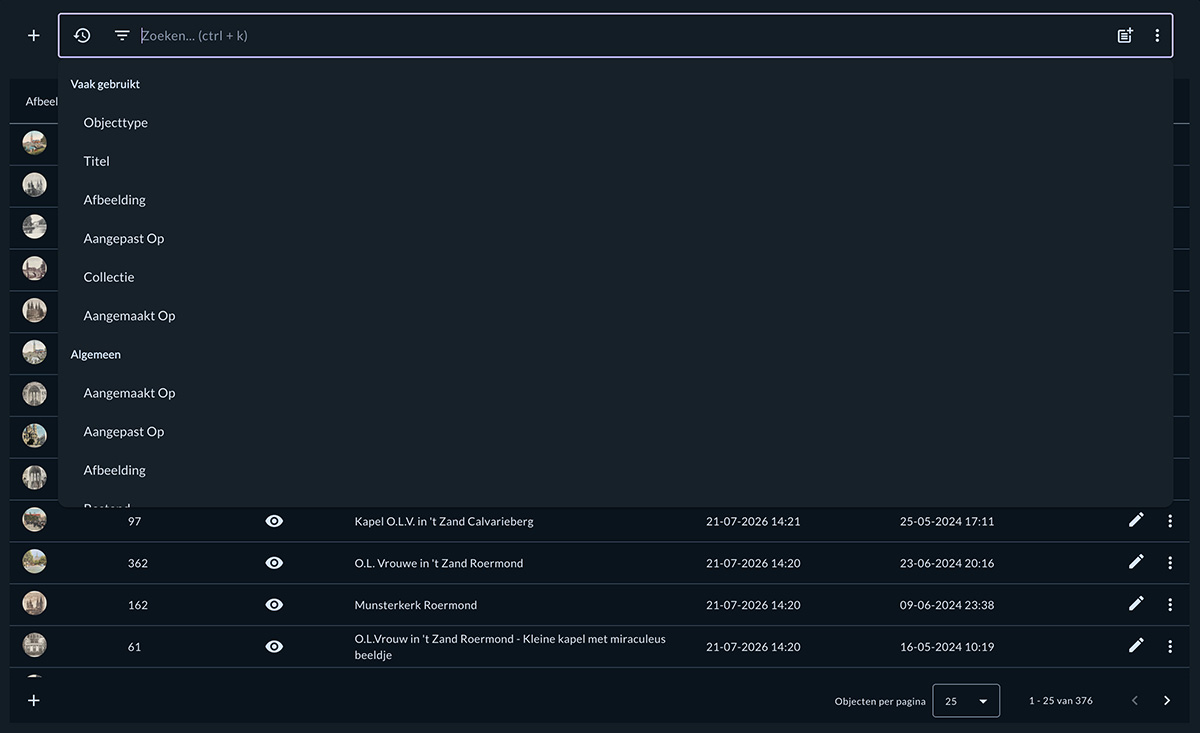
For example, if you click on the name of the “Manufacturer” field, you can create a filter on the corresponding input field. You can then choose from options such as “contains”, “equals to”, “starts with”, or “ends with”. This way, you can search for all manufacturers whose name begins with “Johan”.
Next, apply a filter to the "period" field and set it to filter all works created within a period of 1600 and 1700. With this search query, you will then find, for example, all objects by "Johannes Vermeer". 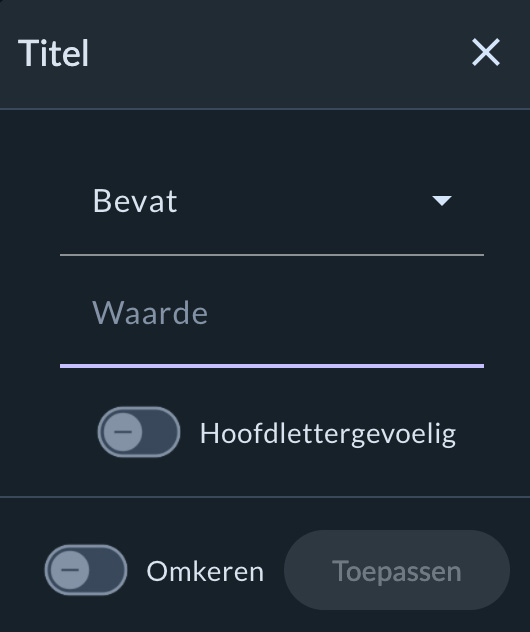
To filter, you can choose from, for example:
- Contains
- Is equal to
- Start with
- Ends with
- Radius
- Period
- Everything before date
- Everything after the date
- With or without image
- File or no file
- Video or no video
- Sound or no sound
- Visible or not
Extra options: - Case sensitive
- Invert filter (for example: search for everything that does not contain a specific word)
You can continue endlessly setting filters and refining your search query to arrive at the desired descriptions or objects (see examples below). 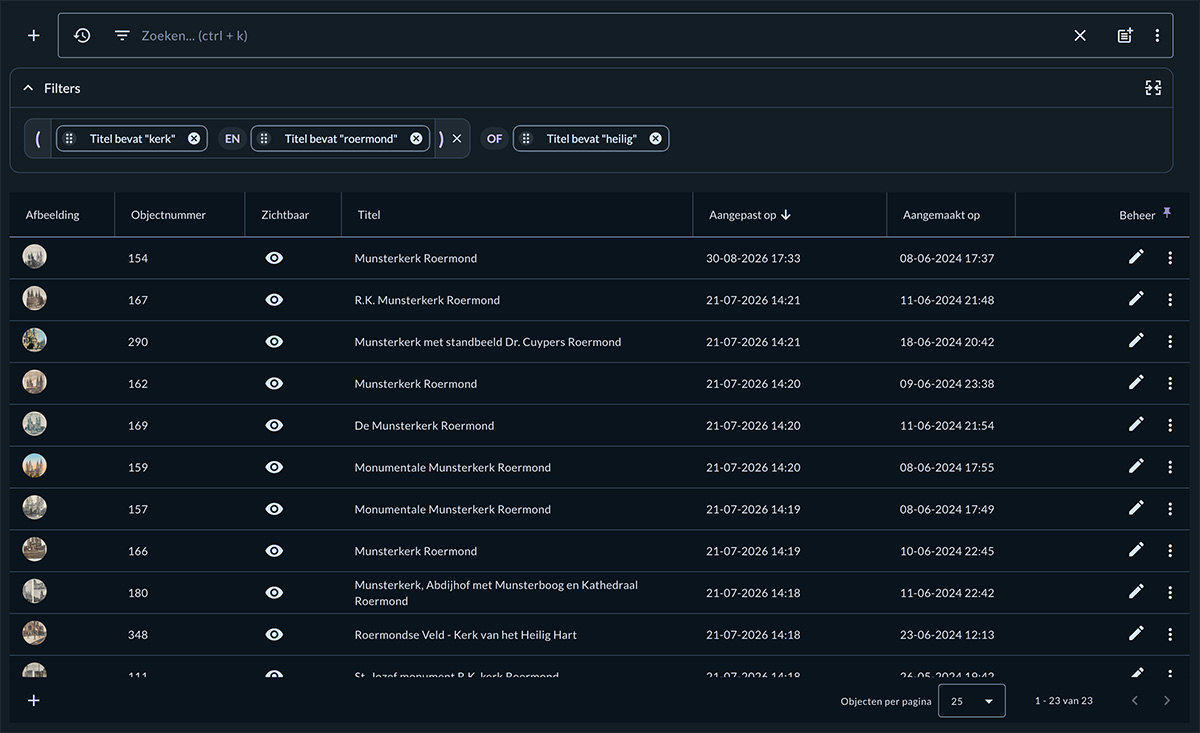
Search for objects via records of a selection list
You can easily search for objects that use a specific record from a selection list.
This works as follows:
- Click in the search bar above the object overview
- type the name of the specific dropdown list
- Select the relevant list in the dropdown below the search bar.
- You will receive a popup with a dropdown containing every record from the relevant selection list.
- Select the relevant record
- Click on 'Apply', the objects that use this record are shown in the overview.
Search with AND, OR, and grouped filters
With KLEKSI's advanced search function, you can combine multiple search filters to search more specifically within your collection. To do this, you use the search operators AND and OR. Additionally, you can group filters to create more complex search queries.
Search with AND and OR
When you add multiple search filters, AND automatically appears between the filters. By clicking on this, you can change it to OR and vice versa.
Search with AND
With EN, an object must meet all set conditions.
For example:
Title contains "church" AND Title contains "Roermond"
KLEKSI only displays objects whose title contains both church and Roermond, such as Munsterkerk Roermond.
Use AND when you want to refine search results by making multiple conditions mandatory.
Search with OR
With OR, an object only needs to meet one of the set conditions.
For example:
Title contains "church" OR Title contains "chapel "
KLEKSI displays all objects whose title contains church, chapel, or both.
Use OF when you want to combine multiple search options, for example to find objects with different names.
Group filters
With the Group function, you can place multiple filters in parentheses. As a result, these filters are evaluated as a single shared condition.
This is especially useful when you want to combine AND and OR within the same search query.
Example:
(Title contains "church" AND Title contains "Roermond") OR Title contains "holy"
KLEKSI now displays all objects of which:
- The title contains both church and Roermond.
- Whether the title contains the word holy.
Thus, for example, Munsterkerk Roermond and Church of the Sacred Heart are found, but also the Sacred Heart statue.
How do you group filters?
Add the desired search filters.
Set the operators AND or OR between the filters.
Click the Group icon to the right of the filters. Checkboxes will appear next to each filter. Select the first and last filter you want to group.
The grouped filters appear in parentheses.
You can set the operators within a group individually and then combine the group with other filters.
Please note: The placement of the parentheses determines how the filters are evaluated collectively. As a result, the same filters may yield different search results with different groupings. 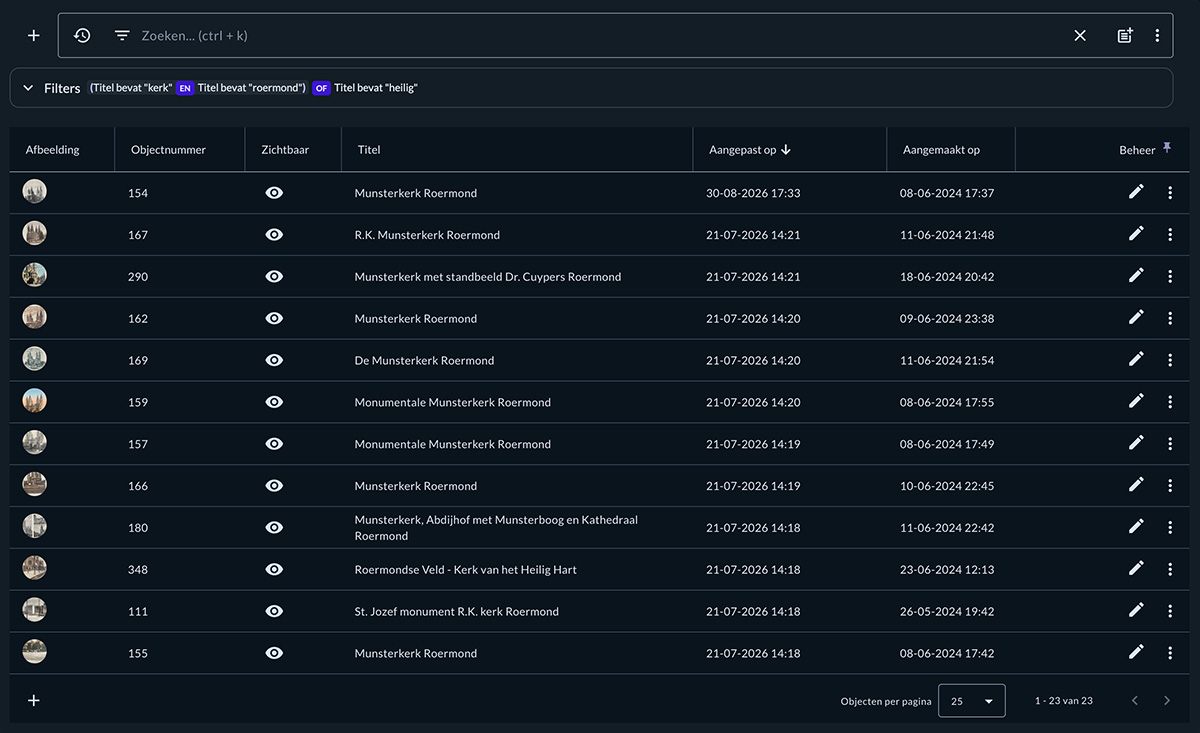
Summary
With AND, you search for objects that meet all conditions. With OR, you search for objects that meet at least one of the conditions.
By grouping filters, you can combine AND and OR and accurately determine which conditions belong together.
This way, you can easily create both broad and very specific search queries within your collection.
- © Copyright KLEKSI - KLEKSI is a product of Sofco
- Privacy policy
- Cookies
- Developed by Sofco